About your water services bill
From 1 July, your new water services provider Tiaki Wai will be sending a separate bill for water services. This is a change from the current system, where you pay for water services through your rates.
This page will have the most up-to-date information about your Tiaki Wai water services bills – how much your bill will be and how to pay.
In April/May, a Tiaki Wai brochure was sent out along with council rates. To find it, click here.
Your first Tiaki Wai bill isn’t due until late July/early August. In the meantime, if you are unsure whether a communication that claims to be from Tiaki Wai is genuine, do not click any links, provide personal or financial information, or reply directly. If in doubt, stop and check. The safe way to contact us is through our official contact form.
Note that Tiaki Wai will not charge you and you won’t be able to make a bill payment until your first bill arrives in late July/early August. Any communication claiming otherwise may be a scam.
The way you pay for water services is changing.
After 1 July 2026, property owners in Lower Hutt, Porirua, Upper Hutt and Wellington will pay Tiaki Wai for water services charges, instead of paying through council rates as you currently do. Property owners will start to receive two separate bills: one for council rates and one for first water services bill.
Your first Tiaki Wai bill will arrive in late July/early August. The due date for paying your first Tiaki Wai bill is 1 September 2026. From then, you will receive water services bills from Tiaki Wai every three months, on the same cycle as your council rates.
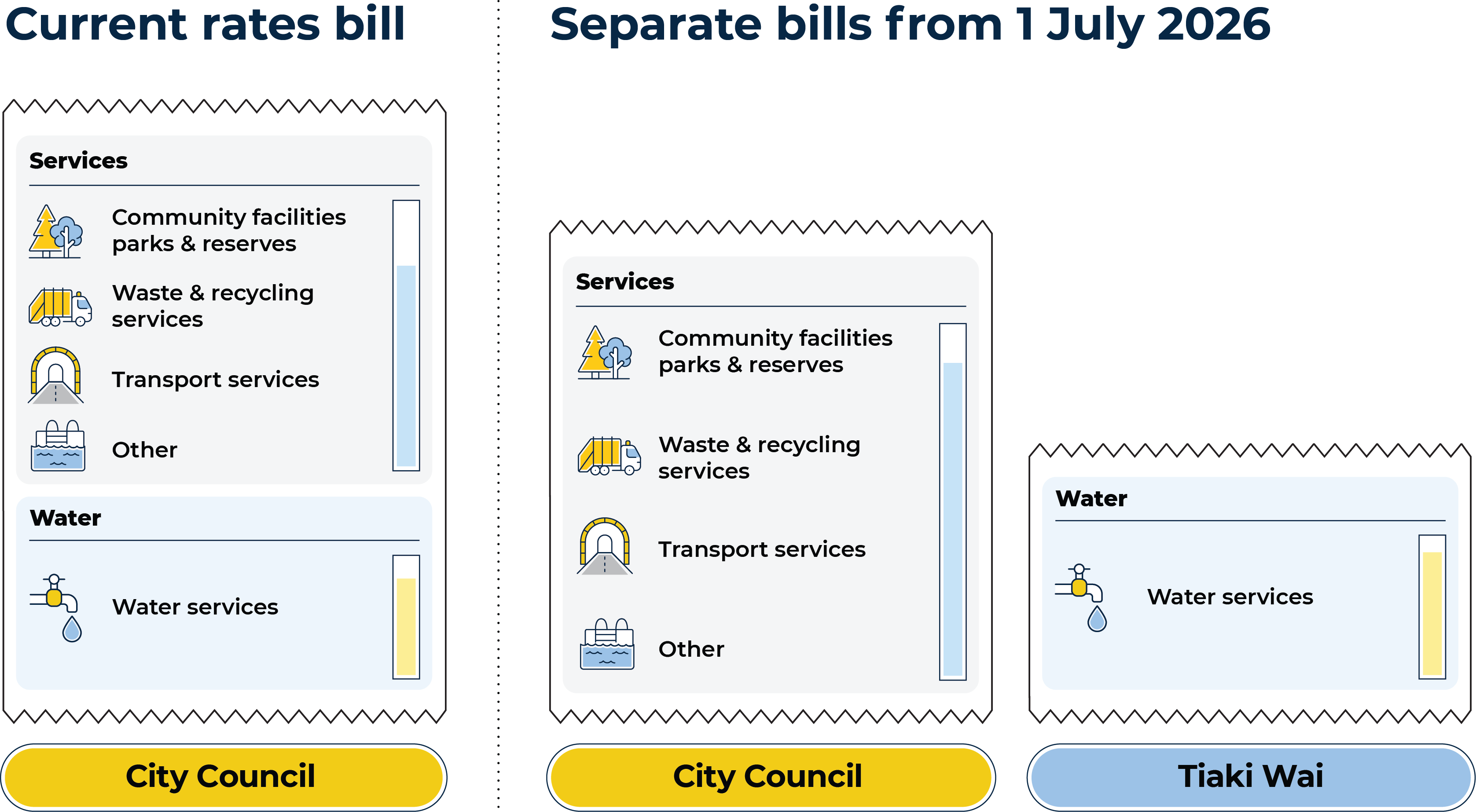
What will you be paying for?
Your water services charges will cover costs for the operation and maintenance of infrastructure networks that: supply drinking water to your property; remove wastewater from your sinks and toilets; and take away stormwater from your downpipes and public areas.
How will you pay your water services bill?
You will be able to pay your bill by direct debit, online banking, phone banking, or over the counter at NZ Post stores that offer bill-payment services.
Initially, Tiaki Wai is working with councils to deliver billing services on its behalf. For this reason, the payment options for your Tiaki Wai bills are slightly different for each council.
Click on your city below for details. If you have property in more than one city, you will need to set up arrangements for each separately.
How much will your water services bill be?
The confirmed water services charges for the coming financial year, 2026/27, are expected to be published on this page on Tuesday 16 June.
For the first year from 1 July 2026, your Tiaki Wai bill will be calculated using much the same approach your council has been using to calculate the water services portion of your rates.
The amount you pay will be higher than you have been paying through rates, but level of increase is yet to be confirmed. It is expected to be lower than the 14.7 percent signalled in the draft Water Services Strategy.
The exact amount will vary from city to city and property to property, in the same way council rates vary.
How will Tiaki Wai calculate water charges?
The approach to calculating water charges is not changing immediately. For the first year from 1 July 2026, Tiaki Wai is calculating water services charges using the water pricing policy and mechanisms currently used by your council, in the interests of continuity. This includes a mix of capital value and fixed charges, different for each council, and only relate to water usage where a customer already has a water meter. You can find out more about this in the Water Services Strategy available on this page (see the summary of the Pricing Policy on page 125).
The long-term goal for Tiaki Wai is to ensure that charges for water services are consistent for similar properties that utilise comparable services, regardless of their geographical location across the service area. (See the draft Pricing Policy available on this page).
This move toward a more consistent regional structure where water charges are ‘harmonised’ across the takiwā (Tiaki Wai region, or service area) is expected to happen no later than 1 July 2031. You will have an opportunity to comment on how and when this transition to a harmonised approach takes place, likely as part of engagement on the 2027-37 Strategy.
The installation of residential water meters would in future allow all for charging to reflect water usage, but this is several years away.
How will Tiaki Wai support people who are in financial hardship and have difficulty paying their water bill?
Water services are essential and your water will not be turned off if you’re struggling to pay your bill. Help will be available for residential customers who are experiencing genuine financial hardship, in line with the Tiaki Wai debtor management and hardship policy.
The draft policy is available online. It structures support in tiers:
Tier 1 – Payment support and engagement
This is the primary response and may include:
- flexible payment plans
- short-term extensions
- referral to budgeting or support services
- remission of late payment fees where hardship support is agreed.
Tier 2 – Practical assistance
Over time, the region will transition to water meters, meaning water charges will be based on how much water is used. As this transition happens, practical assistance may include:
- water efficiency advice
- identification of unusually high usage
- support to address avoidable costs where appropriate.
Tier 3 – Waivers or adjustments
In exceptional and temporary circumstances, limited financial relief may be considered after other options have been explored. Ongoing subsidies or routine debt write-offs are not provided.
We won’t restrict someone’s water supply just because they’re struggling to pay. Restriction would only ever be considered as a last resort, and only where a customer chooses not to engage with us, despite being able to pay.
The final policy and information on how to apply for support will be available before the first bill is sent in late July/early August.