Reporting issues
For now, continue to contact your local council for any water-related issues. You will be informed of any changes to the best point of contact from 1 July 2026 when responsibility for water services transfers to Tiaki Wai.
(October 2025)
About Tiaki Wai
Tiaki Wai is a council-owned company that is established as a water organisation under the Local Government (Water Services) Act 2025.
As a water organisation, Tiaki Wai is limited to providing drinking water supply, wastewater and stormwater services to the Wellington metropolitan area. Tiaki Wai must retain ownership and control of the water services infrastructure and assets, and it must comply with strict financial principles. The shareholding councils have stated in the foundation documents that no dividends will be paid, meaning any surplus must be reinvested.
Find out more in the foundation documents:
Further information about water organisations can be found here.
Tiaki Wai is also subject to the:
Tiaki Wai will be different to Wellington Water because it will operate with more independence. Unlike Wellington Water, from 1 July 2026, Tiaki Wai will:
- Own water assets and infrastructure (transferred from five councils: Greater Wellington, Wellington City, Porirua City, Hutt City, and Upper Hutt City).
- Bill directly for water services, separate to council rates. Independent funding means Tiaki Wai can make more prioritised, sustainable investment and borrowing decisions.
- Operate independently from council’s competing priorities, and their planning, funding, and electoral cycles, meaning Tiaki Wai can have a singular focus on providing safe, reliable, environmentally and financially sustainable water services.
In time, Tiaki Wai will also communicate with customers directly, which will make it more responsive and customer focused.
With greater borrowing capacity and a regional view, Tiaki Wai will be better set up to provide drinking water, manage wastewater, and manage piped stormwater for current and future communities.
To ensure critical work continues and institutional knowledge isn’t lost, Wellington Water staff will be transferred to Tiaki Wai.
Tiaki Wai will be responsive to its customers. It will be overseen by a Partners Committee made up of councils that represent our communities and mana whenua (Taranaki Whānui ki te Upoko o Te Ika and Ngāti Toa Rangatira).
Alongside this, there will also be increased economic and water quality regulation. Some examples of this include:
- The Commerce Commission will monitor compliance with economic regulations in relation to quality, customer protection and price.
- The Water Service Authority - Taumata Arowai - will ensure compliance with drinking and wastewater standards.
- Greater Wellington Regional Council will continue to oversee environmental compliance.
- The Department of Internal Affairs will monitor and seek assurance that Tiaki Wai is financially sustainable and meets the obligations of water services legislation.
Representatives from our five shareholding councils sit on the Partners Committee, which provides governance oversight of Tiaki Wai. Through the Statement of Expectations (SOE), the Partners Committee sets the high-level direction for Tiaki Wai, reflecting the needs and priorities of their communities.
How that direction is delivered is up to Tiaki Wai. Its approach to meeting the expectations set out in the SOE is set out in the Water Services Strategy.
From 1 July, councils will no longer decide funding for individual projects or programmes, set annual water budgets, or determine what people pay for water services. These decisions will be made by Tiaki Wai.
Tiaki Wai will need to maintain close and ongoing working relationships with councils as we deliver on services and maintain the network. This includes where there are services or functions that require collaboration, like management of stormwater and urban planning.
Representatives from mana whenua (Taranaki Whānui ki te Upoko o Te Ika and Ngāti Toa Rangatira) sit on our Partners Committee along with representatives from our shareholding councils.
They will contribute to setting the high-level direction for Tiaki Wai through our Statement of Expectations, reflecting the needs and priorities of their communities. Through the Partners committee they also have a role in oversight of Tiaki Wai.
You can read about the role and specific responsibilities of the Partners Committee in their terms of reference.
Tiaki Wai will need to maintain close and ongoing working relationships with mana whenua as we deliver on services and maintain the network.
See your local council’s website for the background and decisions made in this space:
The decisions Tiaki Wai makes will affect residents, businesses and communities in different ways. It is important that people who are likely to be affected by decisions are informed and have the opportunity to provide their views when necessary.
Our Significance and Engagement Policy sets out how and when you can expect to hear from us.
We commit to engaging with you on the following:
- Water Services Strategy (the 2027-37 Water Services Strategy will be consulted on in early 2027)
- significant Tiaki Wai decisions on projects or proposals, especially where they affect particular locations or communities
- any decisions relating to joint water service provider arrangements outside our current service delivery area
- decisions about significant contracts where the proposal or project hasn’t already been subject to engagement, for example through the Water Services Strategy, and in line with legal requirements.
The legal name Tiaki Wai reflects that the organisation is a partnership between shareholding councils and mana whenua iwi Ngāti Toa Rangatira and Taranaki Whānui ki Te Upoko o Te Ika.
Tiaki Wai in Te Reo Māori means 'carers for water'. This name captures the intent to deliver safe, reliable, environmentally and financially sustainable water services in a way that restores te mana o te wai. The name has been gifted by mana whenua. There was no fee or charge for this gift and there is no ongoing payment.
The email domain @metrowaterwellington was set up in early 2025, before the name Tiaki Wai was confirmed. The team working on establishing Tiaki Wai will continue to use this email address until 1 July 2026.
Customer service and charging
Yes. Currently, you are paying for water services as part of council rates bills. From 1 July 2026, rates will continue to be billed by councils, but you will also receive a separate bill from Tiaki Wai specifically for water services.
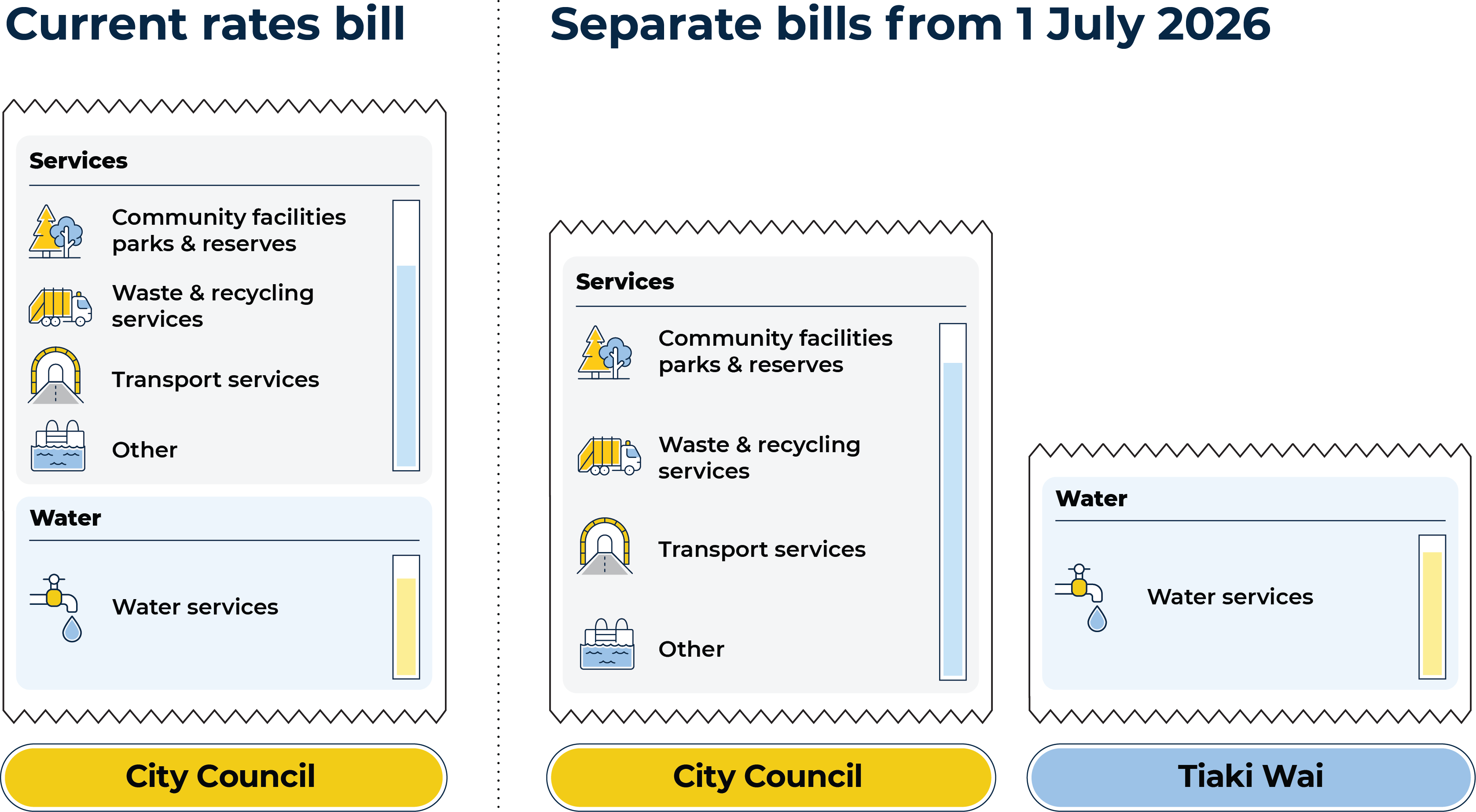
You will start receiving water service bills separate from your council rates bill in the 2026/27 financial year. Expect to see your first Tiaki Wai water services bill around late July/early August 2026.
Property owners are already paying for water through their council rates. On average across the four cities in the current year, property owners paid an average of $2,100 a year, or about $40 a week, through their rates for water services. This figure is an average across the region so some places are paying lower amounts, and some higher.
From 1 July 2026, property owners will be responsible for paying the cost of water services directly to Tiaki Wai, rather than through council rates.
Your water services bill covers costs for the infrastructure networks that supply clean water to your property that’s safe to drink, remove wastewater from your sinks and toilets, and take away the stormwater from your downpipes and the streets and other public areas.
This includes the day-to-day operation and maintenance of pipes, pump stations, drinking water and wastewater treatment plants, and associated infrastructure. Water service charges will also fund long-term investments in renewals, upgrades, and new infrastructure to help with leak reduction, improved wastewater treatment, and the resilience of the network.
Your water services bill pays for the infrastructure that supplies the water, not the water itself.
Over time, customer charges will increase, to meet the cost of delivering reliable and sustainable water services.
The average water services bill for 2026/27 across all four cities will be $2,390 – a 13.3% increase on the $2,100 currently paid through council rates, or about $5.60 a week extra.
The exact amount to be charged each year will depend on the pace of delivering maintenance and upgrades, and the level of cost recovery from new developments.
The forecast cost increases are around a third less than increases likely if councils had continued to be responsible for water services, because of greater borrowing capacity and efficiency gains, but will still present a challenge for many households. Tiaki Wai has a policy for supporting residential customers facing genuine financial hardship.
Use our calculator to estimate the water services charges for your property.
Your council rates bill will reflect the removal of water service charges. However, most councils across New Zealand are increasing their rates, including most of those in the Wellington metropolitan area. Water service charges will also increase to meet the cost of delivering reliable and sustainable water services. As a result, the combined effect is unlikely to reduce your total household costs.
The approach to calculating water charges is not changing immediately. For the 2026/27 year, Tiaki Wai is calculating water services charges using the water pricing mechanisms currently used by councils, in the interests of continuity. This is based on a mix of capital value and fixed charges, it is different for each council and only relates to water usage where a customer already has a water meter. You can find out more about this in the Water Services Strategy (see the summary of the Pricing Policy on page 127).
The long-term goal for Tiaki Wai is to ensure that charges for water services are consistent for similar properties that utilise comparable services, regardless of their geographical location across the service area. (Read more detail in the Pricing Policy).
This move toward a more consistent regional structure where water charges are ‘harmonised’ across the takiwā (territory) is expected to happen no later than 1 July 2031. You will have an opportunity to comment on how and when this transition to a harmonised approach takes place, before final decisions are made.
The installation of residential water meters in future will allow charging to reflect water usage, but this is several years away.
The average water services bill for 2026/27 across all four cities will be $2,390 – a 13.3% increase on the $2,100 currently paid through council rates, or about $5.60 a week extra.
There is information on the forecasted future charges in this media release.
Use our calculator to estimate the 2026/27 water services charges for your property.
Please read our Billing page for more information on water services charges and ways-to-pay.
The first Tiaki Wai bill for water services is due to be sent in late July/early August 2026.
Charges need to rise because the region’s water infrastructure has been under-funded for decades and now requires major work. Between $5.7 and $8.2 billion dollars is needed over 10 years to replace aging pipes, meet modern standards, and support growth. Without higher charges, essential work won’t be able to be done.
We recognise that rising water services costs will be a challenge for some households. Options will be available for those requiring extra support. Our Debtors' Management and Hardship/Waivers Policy is summarised and available for full download on the Billing page.
The rates rebate scheme is operated by the Department of Internal Affairs and administered by councils on behalf of DIA.
The rates rebate scheme has been extended to include both rates and water charges to work out how much you might get as a rates rebate.
Your council will continue to administer the rates rebate scheme and will include your Tiaki Wai water charges when calculating your total rates payable. This means your water charges may help you qualify for a rebate or increase the amount you receive.
Any approved rebate will be applied to your council rates account only. It will not be applied directly to your Tiaki Wai water charges, as these are billed separately.
Paying your water services bill
You will be able to pay your bill by direct debit, online banking, phone banking, or over the counter at NZ Post stores that offer bill-payment services.
If you choose to pay by direct debit, you will need to set up a new direct debit authority before your first payment is due.
You can find information on ways to pay your water services invoices on our billing page.
There will be no change to how you pay your council rates, for example if you have a current direct debit authority for your council rates, that will continue.
Yes. Click on your city below for details on paying, including setting up direct debits. If you have property in more than one city, you will need to set up arrangements for each separately.
Water assets and infrastructure
On 1 July 2026, water network infrastructure will be transferred from council ownership to Tiaki Wai. Because Tiaki Wai will be owned by five shareholding councils, water assets remain in public ownership.
No. Protections against asset sales and privatisation of the company are embedded into the Tiaki Wai constitution and Partners Agreement. Legislation also further prevents privatisation and because Tiaki Wai is owned by councils, assets will remain in public ownership.
From 1 July 2026, all publicly owned assets that support the provision of water services will be transferred to Tiaki Wai.
This will include publicly owned assets on Council owned land as well as freehold (privately owned) property.
Where any public assets are located on private property, Tiaki Wai will take over any existing agreements or arrangements on the same terms. For example, this could involve Tiaki Wai taking over the rights associated with any water easements that are registered on private property. This will not alter anything associated with the ownership of land.
No. Where any publicly owned water assets transfer to Tiaki Wai, there will be no need for private landowners to be involved. This is because the legal transfer will be between the Councils (as current owners) and Tiaki Wai, as the new water organisation that will become the owner of all water services assets.
Water meters
Yes. This will take several years to implement.
To inform our approach to rolling out water meters, Tiaki Wai will be looking at the potential for pilots to test and learn. Full implementation across the takiwā (the region Tiaki Wai covers) is expected to take approximately five to seven years.
Meters are central to managing demand and deferring the need for costly new water sources. They help customers understand and manage their water use. They also help with finding network leaks and private property leaks more quickly. Meters also allow for volumetric charging; that is, paying a charge based on the amount of water used. The details of how volumetric charging would be applied, including the proportion of volumetric and fixed costs, will be developed in coming years, and people will be consulted before changes are made.
A small proportion of our customers - primarily commercial water users - are already using water meters and receive a separate bill related to the amount of water they use.
Read more about our approach to introducing water meters in the Water Services Strategy.
No. Tiaki Wai has a legal requirement to set out forecast investment in the draft Water Services Strategy, so provided some early indicative costs and a roadmap for water meters. This provided transparency about the potential timing and approach but is not the final position.
The Tiaki Wai Board has not decided on the strategy, business case, timing, implementation or budget for water meter implementation.
The Board has asked for more work on costs and benefits as part of developing a business case. This will include consideration of contracting models for delivery, installation and operation of the meters and associated services. Future decisions will also be informed by a trial before any final decisions are made.
The Board is aware of the importance of every dollar of customers’ money and will be looking at options that provides the best value for money.
There will be more information and a chance for people to have a say before the Board makes final decisions.
You can expect to continue to receive separate volumetric/ metered water invoices on the same frequency that you receive them from your council currently; but from 1 July 2026, they will be from Tiaki Wai.
You will also need to pay Tiaki Wai separately for other water service-related charges that have up until now been part of your rates bill (e.g., wastewater and stormwater). This means that, from 1 July 2026, you will get three separate bills: one for non-water related rates from your council, one for water services from Tiaki Wai, and one for volumetric water charges, also from Tiaki Wai.
Tiaki Wai does not recommend that residential property owners apply to have a water meter installed ahead of the Tiaki Wai water metering programme.
Tiaki Wai is planning to roll out water meters to all residential properties in its region (Hutt, Porirua, Upper Hutt and Wellington Cities). This will take several years, potentially starting with pilots in 2026/27. There will be more information and an opportunity for people to have a say before the Tiaki Wai Board makes final decisions on the roll out.
Residential property owners considering applying to install a water meter in advance of this should carefully consider the following:
- Any meter and surface box (housing the meter) installed now is unlikely to be compatible with the future network. Tiaki Wai plans to install smart meters that can be read electronically but has not yet finalised the exact specifications. All meters must be installed in a surface box (also called a toby or manifold box) with fittings that meet standards, but the standards do not yet provide for the installation of a smart meter.
- The costs associated with installing a water meter (ahead of the Tiaki Wai water metering programme roll out) must be met by the property owner (equipment, installation, inspection and administration costs). The installation costs depend on a property’s existing connection and any changes required.
- When the Tiaki Wai water metering programme is rolled out, the direct costs will be borne by Tiaki Wai; while property owners will pay towards this over time through their water services charges, they will not have to pay for the meter or installation directly.
- There is no guarantee that property owners will save money by installing a water meter. The cost equation is different for each property in each city because Tiaki Wai is inheriting systems currently used by four councils, based on a mix of capital value and fixed charges, and with a different rate for metered water usage in each city. The amount of water used by the household will also impact the water charge.
- Metering only relates to drinking water supply and does not impact the charges people will still have to pay for wastewater and stormwater services.
- Tiaki Wai plans in coming years to move to a more consistent pricing system across the region and this may change the balance between fixed charges and metered water charges. Plans for the charging system will be developed over the coming year and there will be a consultation process before decisions are made.
- Under the current billing system, there may be a long delay between water meter installation, and a change to how people are charged. This is because Tiaki Wai billing will be managed out of council rates information databases which are updated once per year. For example, a water meter installed in August 2026 would not be reflected in billing until July 2027.
After these factors have been considered, if a property owner wishes to install a water meter, then they need to complete the water supply connection/alteration form available on their city council website.
Please note:
- Councils are providing interim support for some services until Tiaki Wai sets up new systems. This includes receiving and processing the water connection applications on behalf of Tiaki Wai.
- Any water meter installed must meet Tiaki Wai standards and specifications, so it is compatible with the network and connected into the billing system.
Renters and landlords
As the property owner (and ratepayer), a landlord is currently responsible for paying for water services via council rates invoices.
From 1 July 2026, the property owner/landlord will receive the invoices for water charges from Tiaki Wai and continue to be responsible for paying for water services.
This will not change any arrangements for tenants, as it is the property owner that will receive invoices for water charges and be responsible for paying for water services.
The Tenancy Services website has information about who is responsible for paying water services charges.
Tenants should have a discussion with their landlord if they are interested in how water service costs are factored into rent.
Rural customers
Tiaki Wai can set and collect charges for initial connections to public water services networks, serviceability, and to meet the costs of providing public water services.
Tiaki Wai recognises rural customers get different level of service to urban customers.
If a property is not connected to receive water supply or wastewater services, then the property owner will not be charged for those services.
However:
- you may be required to pay ‘serviceability charges’ in relation to your property if it is within 100m of a public water supply or wastewater network and can be (but is not) connected to that network
- even if you self-supply some water services for your property, you may still be required to charges for aspects of public water services networks that your property benefits from, such as stormwater services.
Each city council area (Hutt, Porirua, Upper Hutt and Wellington) has its own urban stormwater service zones. Areas outside the urban stormwater zones are considered rural and generally rely on natural drainage rather than public stormwater networks. Properties within the rural areas will not be charged by Tiaki Wai for stormwater services in the 2026/27 year.
Rural rate payers who previously paid for stormwater as part of their council general rates, and are outside of a stormwater service zone, will not be charged by Tiaki Wai for stormwater services in the 2026/27 year.
Developers
Yes, Tiaki Wai will continue to charge development contributions, based on the existing policies of each shareholding council. This will apply to consent and connection applications made after 1 July 2026.