FAQ
Popular Questions
Am I going to get a separate bill for water?
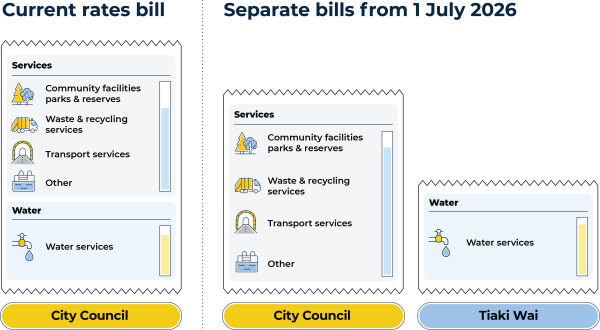
Yes. Currently, you are paying for water services as part of council rates bills. From 1 July 2026, rates will continue to be billed by councils, but you will also receive a separate bill from Tiaki Wai specifically for water services.
Will there be options available for low-income households?
We recognise that rising water services costs will be a challenge for some households. Options will be available for those requiring extra support. Read our Debtors' Management and Hardship Policy.
Why do I have to start paying for water?
Property owners are already paying for water through their council rates. On average across the four cities in the current year, property owners paid an average of $2,100 a year, or about $40 a week, through their rates for water services. This figure is an average across the region so some places are paying lower amounts, and some higher.
From 1 July 2026, property owners will be responsible for paying the cost of water services directly to Tiaki Wai, rather than through council rates.
Should I arrange to have a water meter installed at my residential property?
Tiaki Wai does not recommend that residential property owners apply to have a water meter installed ahead of the Tiaki Wai water metering programme.
Tiaki Wai is planning to roll out water meters to all residential properties in its region (Hutt, Porirua, Upper Hutt and Wellington Cities). This will take several years, potentially starting with pilots in 2026/27. There will be more information and an opportunity for people to have a say before the Tiaki Wai Board makes final decisions on the roll out.
Residential property owners considering applying to install a water meter in advance of this should carefully consider the following:
- Any meter and surface box (housing the meter) installed now is unlikely to be compatible with the future network. Tiaki Wai plans to install smart meters that can be read electronically but has not yet finalised the exact specifications. All meters must be installed in a surface box (also called a toby or manifold box) with fittings that meet standards, but the standards do not yet provide for the installation of a smart meter.
- The costs associated with installing a water meter (ahead of the Tiaki Wai water metering programme roll out) must be met by the property owner (equipment, installation, inspection and administration costs). The installation costs depend on a property’s existing connection and any changes required.
- When the Tiaki Wai water metering programme is rolled out, the direct costs will be borne by Tiaki Wai; while property owners will pay towards this over time through their water services charges, they will not have to pay for the meter or installation directly.
- There is no guarantee that property owners will save money by installing a water meter. The cost equation is different for each property in each city because Tiaki Wai is inheriting systems currently used by four councils, based on a mix of capital value and fixed charges, and with a different rate for metered water usage in each city. The amount of water used by the household will also impact the water charge.
- Metering only relates to drinking water supply and does not impact the charges people will still have to pay for wastewater and stormwater services.
- Tiaki Wai plans in coming years to move to a more consistent pricing system across the region and this may change the balance between fixed charges and metered water charges. Plans for the charging system will be developed over the coming year and there will be a consultation process before decisions are made.
- Under the current billing system, there may be a long delay between water meter installation, and a change to how people are charged. This is because Tiaki Wai billing will be managed out of council rates information databases which are updated once per year. For example, a water meter installed in August 2026 would not be reflected in billing until July 2027.
After these factors have been considered, if a property owner wishes to install a water meter, then they need to complete the water supply connection/alteration form available on their city council website.
Please note:
- Councils are providing interim support for some services until Tiaki Wai sets up new systems. This includes receiving and processing the water connection applications on behalf of Tiaki Wai.
- Any water meter installed must meet Tiaki Wai standards and specifications, so it is compatible with the network and connected into the billing system.
Are water meters going to be introduced?
Yes. This will take several years to implement.
To inform our approach to rolling out water meters, Tiaki Wai will be looking at the potential for pilots to test and learn. Full implementation across the takiwā (the region Tiaki Wai covers) is expected to take approximately five to seven years.
Meters are central to managing demand and deferring the need for costly new water sources. They help customers understand and manage their water use. They also help with finding network leaks and private property leaks more quickly. Meters also allow for volumetric charging; that is, paying a charge based on the amount of water used. The details of how volumetric charging would be applied, including the proportion of volumetric and fixed costs, will be developed in coming years, and people will be consulted before changes are made.
A small proportion of our customers - primarily commercial water users - are already using water meters and receive a separate bill related to the amount of water they use.
Read more about our approach to introducing water meters in the Water Services Strategy.
What kind of organisation is Tiaki Wai?
Tiaki Wai is a council-owned company that is established as a water organisation under the Local Government (Water Services) Act 2025.
As a water organisation, Tiaki Wai is limited to providing drinking water supply, wastewater and stormwater services to the Wellington metropolitan area. Tiaki Wai must retain ownership and control of the water services infrastructure and assets, and it must comply with strict financial principles. The shareholding councils have stated in the foundation documents that no dividends will be paid, meaning any surplus must be reinvested.
Find out more in the foundation documents:
Further information about water organisations can be found on the Department of Internal Affairs website.
Tiaki Wai is also subject to the:
Search
{{category.title}}
{{ question.title }}
{{ question.title }}
No results found