IAF (Infrastructure Acceleration Fund) - Hutt Valley Wastewater and Stormwater Improvements Project
This project is enabling major water infrastructure upgrades including pipelines, pumping stations, and storage tanks to support future housing In Lower Hutt.
If you have any questions about this work, please contact:
Wellington Water, 04 912 4400
Latest Updates
The Infrastructure Acceleration Fund (IAF) is a funding initiative to help unlock development opportunities and enable more homes to be built. In Lower Hutt, this project is enabling major water infrastructure upgrades including pipelines, pumping stations, and storage tanks to support future housing.
Benefits
This project is crucial for Lower Hutt’s future. Here’s how it will help:
- More homes for our growing city – this infrastructure will pave the way for more than 3,500 new homes, including higher-density and more affordable housing options.
- Better infrastructure – an added benefit of upgrading our stormwater and wastewater systems is that it will help prevent flooding and improve overall reliability.
- Future-proofing our city – these improvements will support the city’s long-term growth and ensure our infrastructure keeps up with demand.
We’ve followed a robust assessment process to systematically evaluate potential options. This process includes input from key stakeholders and technical experts through a series of collaborative workshops. Options were assessed against essential criteria, eliminating those that did not meet project objectives. This has led to the selection of a preferred option.
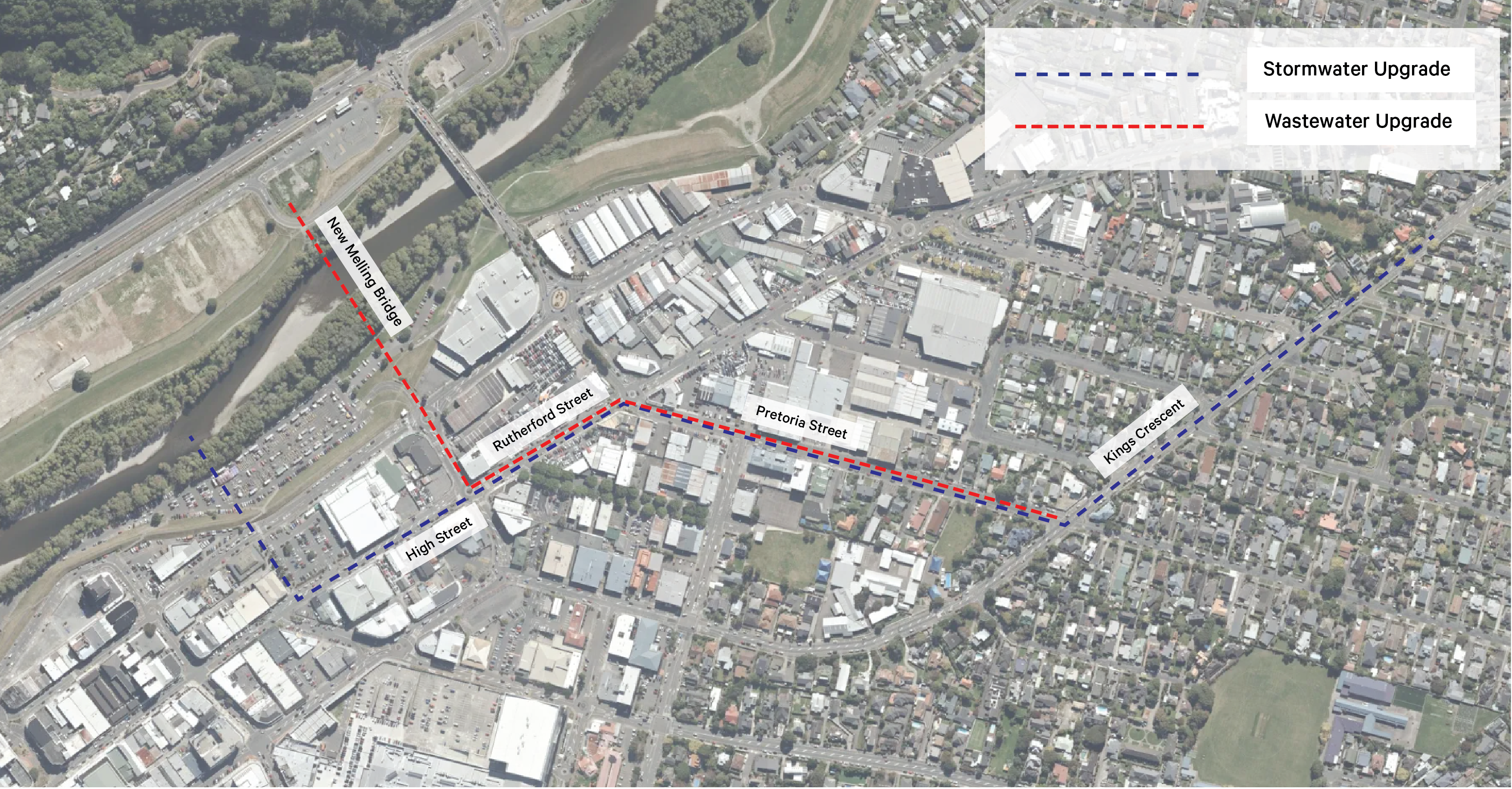
The proposed route includes some areas of Kings Crescent and Pretoria Street, connecting to Te Awa Kairangi and the Western Hills sewer main.
You can find more detailed information about the different concept designs, including technical reports and multi-criteria analysis of the options considered, here.
The project is now in the design and consenting phase, with resource consent planned for mid-2026 and construction expected to begin in mid 2027, subject to approvals.
Timeline
| Late 2025 | Pre-implementation phase |
| Now to mid 2026 | Design development and preparation of resource consent application |
| Mid 2026 | Resource consent lodged |
| Mid to late 2026 | Resource consent process and final design |
| Mid 2027 | Construction expected to begin (subject to approvals) |
The following summaries outline how Council determined the preferred options for the Infrastructure Acceleration Fund (IAF) stormwater and wastewater upgrades, noting that both projects:
- have the objective of providing infrastructure capacity improvements of a scale to enable the construction of 3,520 houses in the Hutt Valley
- went through rigorous multi-criteria assessment of alternatives using expert scoring panels
- involved feedback from mana whenua
- prioritised strong flood and overflow performance, cost efficiency, and low construction risks
- aimed to reduce existing environmental and public health risks without triggering worse impacts elsewhere.
You can access the feasibility reports here:
As outlined in the reports, the preferred option offers the most balanced solutions for enabling growth, avoiding future flooding or sewer overflows, and staying within budget.
Summary - Stormwater upgrade
What options were considered?
Seven different options for pipe alignment and pump station location were developed to improve the management of floodwater, including features such as:
- widening the Opahu Stream channel itself
- building new underground stormwater pipes to relieve pressure/improve capacity of the existing Opahu Stream
- installing new pump stations at various locations (e.g., Eastern Hutt School, St Bernard’s College, Chilton St James School)
- storing floodwaters temporarily in open spaces like Hutt Rec Ground
Which is the preferred option?
The preferred option includes:
- a gravity interceptor pipe to collect stormwater from Kings Crescent
- a pump station near Eastern Hutt School on the Opahu stream
- A pipe (rising main) to carry the water through Pretoria Street to a new outlet into the Hutt River (Te Awa Kairangi).
Why was this chosen?
This option was selected because it:
- offers the best balance of cost, effectiveness, and construction practicality
- is better able to handle the expected stormwater volumes from 3,500+ new homes
- avoids “fatal flaws” (e.g., poor flood performance, excessive environmental or cultural impacts)
- was considered more buildable and less risky than the others, particularly in terms of underground water risks and potential impact on the Waiwhetū aquifer.
Comparison table
| Option | Key features | MCA outcome |
| 1a: Stream improvements + Eastern Hutt School pump station | Upgrades stream channel and culverts, pump station at Eastern Hutt School | Not preferred - lower capacity, higher flood risk |
| 1b. Gravity interceptor pipe along Kings Cresent + Eastern Hutt School pump station | Adds new pipe and pump station near Eastern Hutt School | Preferred - good capacity, cost effective, manageable risks |
| 2. St Bernard's College pump station and rising main to outlet 35 | An intake from exisiting stormwater + pump station on the grounds of St Bernard's College + rising main along Pretoria St | Similar to Option 4 but addresses a smaller area of flooding |
| 3a. Hutt Rec Ground channel storage | Open channel storage in Hutt Rec Ground | Not preferred - long disruptions caused by digging up park, and storage limitations |
| 3b. Hutt Rec Ground pump station | Pump station at Hutt Rec Ground discharges via Woburn | Not preferred - cost and land constraints |
| 4. Chilton + Ridderford Dual pump station | Dual pump stations, complex network | Not preferred - more complex to build and maintain, with higher property impact |
| 5. Hutt Rec Northwest pump station with two stream intakes | Dual intakes to one pump station in Northwest Hutt Rec | Not preferred - more complex to build and maintain, with limited benefits |
Summary - Wastewater upgrade
What options were considered?
Five different options were shortlisted as possible solutions to a predicted lack of wastewater capacity and an impediment to future growth. These were chosen after carefully comparing costs, flooding and overflow reduction, cultural impacts, disruption, and resilience to earthquakes.
The options mostly involved:
- cutting and bypassing existing sewers (e.g., High Street or Pretoria Street)
- diverting wastewater to new pump stations at different locations (Ewan Bridge, Hutt Rec, Ariki Street)
- using pipes (called rising mains) to carry pumped wastewater to the existing Western Trunk Main (WTM) or Barber Grove Pump Station.
Which is the preferred option?
Option 2, located in Pretoria Street and connecting to the Western Hills Trunk Main, scored the highest in initial assessments. However, after further review, it became clear that this option introduced serious operational risks:
- the Western Hills Trunk Main already has issues during heavy rain
- it could cause overflows upstream at Silverstream or Ava Pump Station.
This prompted a redesign—called the “Western Trunk Main Option”—with improvements like:
- increasing pipe size
- adding a large storage tank (2 million litres)
- adding real-time controls for better system management.
Why was this chosen?
The updated version of Option 2 was ultimately chosen because it:
- offered the best balance of cost, performance, and construction simplicity
- significantly reduced future overflows
- was the most cost-effective solution
- met the future service standards (one overflow every 2 years)
- minimised disruptions and construction issues compared to other options.
Although Option 4 avoided the problematic Western Trunk Main, it was more expensive and didn’t reduce overflows as effectively.
Comparison table
|
Option |
Key features |
MCA Outcome |
|
1: High St to Ewan Bridge |
Bypass along High St to Ewan Bridge |
Not preferred – highest cost, significant disruption to High St, limited access for maintenance |
|
2: Pretoria St to Pump Station + WTM |
Bypass along Pretoria St to Western Trunk Main |
Preferred – best cost-benefit ration, manageable with upgrades |
|
3: Pretoria to North Hutt Rec Pump Station |
Bypass to North Hutt Rec with Western Trunk Main discharge |
Not preferred – similarities with Option 2 but with higher cost, lower resilience |
|
4: Pretoria to South Hutt Rec Pump Station |
Bypass to South Hutt Rec, discharges to Barber Grove |
Runner-up – avoids Western Trunk Main, good cultural alignment, but a much longer, costlier route with similar proximity to roads and homes |
|
5: Potomaru to Ariki + Ewan Bridge (Dual Pump Stations) |
Two pump stations, one at Ariki, another at Ewan Bridge |
Not preferred – more complex and costly, with two stations to build and maintain, with limited benefit |
FAQs
How did you reach the '3,500 houses' number for central Lower Hutt growth?
In our application for IAF funding, we proposed to build 3,520 new houses between 2022 and 2035. The modelling was based on the predicted growth in the Hutt Valley floor that would be made possible by the additional capacity created by the stormwater (and wastewater improvements)
The number comprised of 526 public housing dwellings, 255 Papakāinga dwellings, 2,425 lower cost dwellings and 314 other dwellings. The dwellings will be predominantly medium density townhouses and high-density apartments.
Are there any pump stations in the Wellington region that might be similar to what you're constructing?
Two recent examples of local Wastewater Pump Stations like this project are:
- Taranaki Street Pump Station
- Dixon Street Pump Station
Note, the Porirua Central Wastewater Storage Facility has also been constructed, however the 7,000m3 storage tank for this facility is significantly larger than the 2,000m3 capacity proposed by IAF.
How will noise be factored into the designs?
The stormwater pump station will only operate very intermittently, for a duration of a few hours during large rainstorms. The pumps will be located underground so there will be little noise at the site boundary. There may be electrical noise (humming or similar) from aboveground electrical equipment when the pumps are running. If the decision is made to include a permanent electrical generator, there will be some occasional noise of short duration when this is test-run.
The wastewater pump station will also have pumps and will be located underground so there will be little to no noise at the site boundary. There may be electrical noise (humming or similar) from above ground electrical equipment when the pumps are running.
Any noise emitted from the pump stations will be within the noise thresholds set by the District Plan. This will be considered in more detail in the next stage of design, including the consenting of the pump stations.
What infrastructure is being built?
The proposed infrastructure includes a pumpstation and storage tank which include pumps powered by electricity, piping, valves, and control systems. Additionally, there will be odour control and ventilation systems, generators, and access points such as loading bays within the site boundary.
Will all the infrastructure be underground?
The pump station and storage tanks will be a mixture of above-ground and below-ground infrastructure. Above-ground and below-ground will need to be explored as part of detailed design and public engagement process.
Why aren't you putting the wastewater storage underground?
Council explored multiple solutions and determined the below-ground option to be a risk, given the proximity to natural aquifer.
Is there a preliminary route establishment that has been shared so we can review any potential impact on our location?
Yes, we have established a preliminary route. The team has conducted a multi-criteria assessment (MCA) to evaluate the most feasible options that deliver the best outcomes. This approach ensures we have a viable option that aligns with the project objectives.
The exact routes and locations for the project are still being determined as part of the detailed design phase. This is expected to be completed in late 2026. Once confirmed, the information will be shared with affected and interested parties.
How big will the structure be and what will they look like?
The exact size and specifications of the infrastructure will be confirmed in the detailed design phase. The expected size is significant enough to require property acquisition.
Will it be noisy?
Construction will involve activities such as digging in the road reserve, operating machinery, and site work, which will understandably generate some noise. These concerns are being considered as part of the design process and precautions will be taken to prevent this.
How is Council addressing concerns about smell?
These concerns are being considered as part of the design process and precautions will be taken to prevent this.
What are you doing to manage traffic disruptions?
Council will plan works to minimise disruptions, and regular updates will be provided to keep residents informed about progress and any anticipated impacts.
Construction is likely to involve digging in the road reserve and work on specific sites acquired for the project. Traffic management and detours in place for residents to move safely around the work areas.
We’ll share more details as project timelines are confirmed.
Will this affect house prices and potentially devalue my property? Is ther a modelled house price impact analysis you can share, or data from similar projects in other regions?
There is no publicly available modelled house price impact analysis for this project. However, similar projects elsewhere have shown that infrastructure improvements can enhance property values over the long term, especially if they contribute to increased housing supply and resilience.
Why haven't you engaged with the community before now?
Hutt City Council needed to complete the multi-criteria assessment (MCA) to understand which options were most feasible and would provide the best outcomes, and identify which landowners would be impacted. This process included consideration of whether the required property would be commercial or residential. Due diligence was completed on the different alternatives.
Wellington Water also went through their own MCA process on the wastewater options.
Are we considered an affected or interested party in terms of consenting?
We are still in the early stages of design. As the design progresses, we will gain a clearer understanding of the potential effects and the associated consenting requirements, including who the affected and interested parties are and how we will engage with property owners in the project area going forward.
When will consultation occur?
The community will have opportunities to provide input as the project moves through the detailed design phase. Regular updates and consultations will be shared through this website and other communication channels.
All Updates
The Infrastructure Acceleration Fund (IAF) is a funding initiative to help unlock development opportunities and enable more homes to be built.
In Lower Hutt, this project is enabling major water infrastructure upgrades including pipelines, pumping stations, and storage tanks to support future housing.
This project is crucial for Lower Hutt’s future. Here’s how it will help:
- More homes for our growing city – this infrastructure will pave the way for more than 3,500 new homes, including higher-density and more affordable housing options.
- Better infrastructure – an added benefit of upgrading our stormwater and wastewater systems is that it will help prevent flooding and improve overall reliability.
- Future-proofing our city – these improvements will support the city’s long-term growth and ensure our infrastructure keeps up with demand.
Current Status
The project has progressed through the initial design phase, where the preferred option for routing of the stormwater and wastewater pipes has been identified.
The project is currently in its pre-implementation stage, which is scheduled to be completed in early to mid 2026. Following this it will move into a 12 month detailed design phase, where we will apply for the necessary consents, and finalise any land or access agreements. Construction is due to commence in early/mid 2027 and should take approximately two years to complete.